
Georgia DDS Motorcycle Practice Test 4
Test 4 of 6. Pick an answer for each question to see if it is right and why; your score appears at the end. You need 30 correct answers to pass, the same ratio as the real Georgia test.
- Questions40
- Correct to pass30
- Passing score75%
- Minimum age16 years
-
1. You approach an intersection where the signal is flashing yellow. What should you do?
Show answer
Answer D: Slow down and cross the intersection with caution
A flashing yellow signal warns you to slow down and cross with care; it does not require a stop, but it does not give you priority either.
-
2. What does a Georgia Motorcycle Safety Program license test waiver allow, and how long is it valid?
Show answer
Answer C: It lets the rider bypass the knowledge test and the on-cycle skills test, and it is valid for 90 days
Graduates of the Basic RiderCourse or Basic RiderCourse 2 receive a 90-day license test waiver that bypasses both the knowledge test and the on-cycle skills test at a DDS Customer Service Center.
-
3. You must slow suddenly on a highway and a vehicle is following close behind you. What helps prevent a rear-end collision?
Show answer
Answer D: Tapping the brake pedal early so your brake lights flash a warning
Early brake light flashes give the driver behind more time to react, and slowing gradually instead of suddenly reduces the chance of being struck.
-
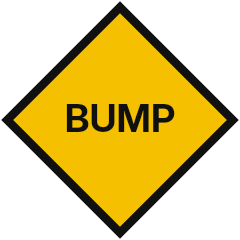
4. Why does this warning matter more on a motorcycle than in a car?
Show answer
Answer B: Because a sudden jolt can unsettle a two-wheeled machine and the rider can lose control
A jolt can push a motorcycle off line or lift a wheel, so a rider slows early, comes slightly off the seat and keeps a relaxed but firm hold on the handlebars.
-
5. Why should you stay out of an intersection you cannot clear, even on a green light?
Show answer
Answer B: Because you would block cross traffic when their signal turns green
A vehicle stranded in the intersection blocks the cross street when its light turns green, which stalls the whole junction and traps emergency vehicles.
-
6. Which Georgia violations carry the maximum of six points?
Show answer
Answer C: Unlawful passing of a stopped school bus and aggressive driving
Georgia's points schedule assigns six points, the highest fixed value, to unlawful passing of a school bus and to aggressive driving.
-
7. Besides holding a device, what else does the Hands Free Georgia Law forbid?
Show answer
Answer A: Writing, sending or reading any text-based communication
Georgia bans writing, sending or reading text-based communications such as text messages, instant messages, electronic mail and internet data.
-
8. Why is a U-turn on a one-way street a problem?
Show answer
Answer A: You would end up facing the wrong way against all the traffic
Every lane of a one-way street runs the same way, so turning around leaves you driving head-on against all of the traffic.
-
9. The green arrow protecting your turn changes to a steady yellow arrow. What is it telling you?
Show answer
Answer A: The protected turn is ending and you should prepare to stop
A steady yellow arrow warns that the arrow movement is being terminated and that a red indication will follow.
-
10. A helmet falls from the seat onto a hard floor but shows no cracks. What should the owner do?
Show answer
Answer C: Replace it or have it checked, because the liner can be crushed inside
The foam liner can be compressed with no outside sign, and crushed foam will not absorb a second impact, so a helmet that has taken a hard knock should be replaced.
-
11. How does alcohol typically affect a driver's vision?
Show answer
Answer D: It blurs vision, weakens night vision and narrows attention to the sides
Alcohol slows the eye muscles and the brain's processing of what is seen, degrading focus, night vision, depth perception and awareness of movement at the edges of the field of view.
-
12. A rider chooses an open face helmet. What does that choice make necessary?
Show answer
Answer A: Separate goggles or a face shield, because the face is uncovered
An open face helmet gives no eye or face protection, so the rider must add goggles or a face shield that will not shatter and that seals against the wind.
-
13. When must a passenger keep both feet on the footrests?
Show answer
Answer C: At all times, including while the motorcycle is stopped
Feet stay on the footrests even at a stop, because a foot put down or swung out can unbalance the motorcycle or be caught by the road.
-
14. What is the correct swerving technique?
Show answer
Answer D: Press the handgrip on the side you want to go and look toward the escape route
A swerve is two quick countersteering inputs, and because the motorcycle goes where the rider looks, the eyes belong on the open space.
-
15. A curb lane is marked BUS ONLY 7 AM TO 9 AM. What may the driver of a car do?
Show answer
Answer A: Use the lane outside those hours
A part-time bus lane is reserved only during the posted period, and outside it the lane serves general traffic like any other.
-
16. In Georgia, what must a driver do to pass a bicycle when changing lanes is not possible?
Show answer
Answer D: Slow to at least 10 miles per hour below the limit or to 25, whichever is more, and leave three feet
Where a lane change is impossible or unsafe, Georgia requires the driver to slow to at least 10 miles per hour under the posted limit or to 25 miles per hour, whichever is greater, and to leave three feet of space.
-
17. What is the status of the Georgia Digital License and ID while you are driving?
Show answer
Answer A: It does not replace the physical card while you are driving
Georgia offers the digital license free of charge, but it is not a replacement for the physical card while driving, and an officer may require the plastic card.
-
18. You come up behind a group of cyclists riding two abreast on a narrow rural road. What should you do?
Show answer
Answer A: Wait for a clear stretch and pass them as one group
Passing a group as a single unit when the way ahead is clear is safer than several rushed passes, and cutting through the group leaves nobody any escape room.
-
19. What does Georgia charge a parent who asks the department to revoke a teenager's permit or license?
Show answer
Answer B: A non-refundable fee of $10
Georgia charges a non-refundable fee of $10 for a request to revoke a minor's permit or license.
-
20. When does Georgia law require headlights to be on?
Show answer
Answer C: From one-half hour after sunset to one-half hour before sunrise, at any time it is raining, and when visibility is limited
Georgia requires headlights from one-half hour after sunset until one-half hour before sunrise, whenever it is raining, and whenever visibility is limited.
-
21. When must a Georgia driver notify law enforcement after a crash?
Show answer
Answer D: When anyone is injured or killed, or property damage exceeds $500
Georgia requires immediate notification of the nearest law enforcement agency where anyone is hurt or killed or where property damage is more than $500.
-
22. What penalty does Georgia attach to driving so slowly that it impedes the normal movement of traffic?
Show answer
Answer B: A fine of up to $1,000 and three points on the driving record
Georgia punishes impeding traffic with a fine of up to $1,000 and three points, except where the reduced speed is necessary for safe operation.
-
23. A city transit bus ahead of you has stopped at the curb with its passenger door open. What does the law require of you?
Show answer
Answer D: Nothing special, but pass slowly and watch for people
The mandatory stop applies to a school bus showing red flashing lights, not to a transit bus, though a careful driver still slows for crossing passengers.
-
24. How long is the first suspension for a Georgia driver under 21 convicted of DUI at 0.08 or above, or who refuses testing?
Show answer
Answer D: A minimum of twelve months
Georgia imposes a minimum twelve-month suspension on an under-21 driver for a first DUI at 0.08 or above or for refusing the state test.
-
25. How does the distance needed to stop change when a rider doubles speed?
Show answer
Answer D: It grows to roughly four times the original distance
Braking distance rises with the square of speed, so twice the speed needs roughly four times the distance in which to stop.
-
26. Why should you avoid parking over tall dry grass or a pile of dead leaves?
Show answer
Answer B: Because the hot exhaust can set the dry material on fire
The exhaust system stays hot for a long time after a drive and can ignite dry vegetation underneath the vehicle.
-
27. How should space management change with a passenger aboard?
Show answer
Answer B: Allow a greater following distance and wait for larger gaps in traffic
A loaded motorcycle accelerates and stops more slowly, so it needs more room ahead and bigger gaps to merge, to pass or to cross traffic.
-
28. A pedestrian is crossing at a corner where no crosswalk is painted on the pavement. What is your duty?
Show answer
Answer A: Yield, because a legal crosswalk exists at the corner even without paint
Every intersection has a crosswalk whether or not it is marked, and drivers must yield to pedestrians crossing there.
-
29. In how many ways does the Georgia manual say a driving privilege can be withdrawn?
Show answer
Answer B: Four: cancellation, revocation, suspension and commercial disqualification
The Georgia manual describes four types of withdrawal: cancellation, revocation, suspension and commercial driver disqualification.
-
30. You are stopped at a stop sign waiting to turn onto a highway where traffic moves at 55 mph. How should you choose your gap?
Show answer
Answer A: Wait for a much larger gap than the one you would accept on a city street
Fast traffic covers ground while you are still accelerating, so the gap that feels adequate at 25 mph is dangerously short at highway speed.
-
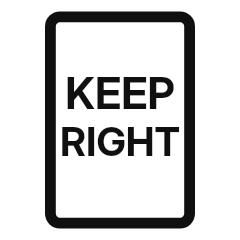
31. A driver ignores this sign and passes on the opposite side. What is the main risk?
Show answer
Answer B: Ending up on the wrong side of a divider, facing traffic coming the other way
The sign settles which side of a fixed divider is the legal one, so taking the other side sends the vehicle into the opposing stream or straight at the obstruction.
-
32. Unless a sign says otherwise, what is the Georgia speed limit on a rural interstate?
Show answer
Answer A: 70 miles per hour
Georgia allows 70 miles per hour on a rural interstate, while urban interstates and multi-lane divided highways are set at 65.
-
33. What Georgia speed limit applies where none of the specific categories in the manual fits and no limit is posted?
Show answer
Answer B: 55 miles per hour
Georgia's general schedule ends with 55 miles per hour for all areas not covered by a listed category or by a posted sign.
-
34. Does wearing properly fitted earplugs stop a rider from hearing important sounds?
Show answer
Answer C: No, they lower overall noise while horns and speech still register
Earplugs reduce the wind roar that masks everything else, so riders wearing them often hear traffic more clearly, not less, while their hearing is protected.
-
35. You must park on soft ground or on asphalt softened by heat. What should you do about the sidestand?
Show answer
Answer A: Put a flat, firm object under the stand to spread the load
A sidestand concentrates the weight of the machine onto a very small area, and on soft ground it sinks in until the motorcycle falls over.
-
36. A sign reads REDUCED SPEED LIMIT AHEAD. What does it tell you?
Show answer
Answer D: A lower limit begins further along the road
The sign gives advance notice so a driver can slow gradually, and the new figure takes effect at the speed limit sign that follows.
-
37. Unless a sign says otherwise, what is the Georgia speed limit in an urban or residential district?
Show answer
Answer D: 30 miles per hour
Georgia sets 30 miles per hour as the general maximum in urban and residential districts when no other limit is posted.
-
38. How does Georgia punish littering from a vehicle?
Show answer
Answer A: A misdemeanor damage to property conviction, a fine of up to $1,000 and up to 12 months in jail
Georgia treats littering as a misdemeanor damage to property conviction carrying a fine of up to $1,000 and up to twelve months in jail, and a court may order the offender to clear litter.
-
39. How old must the responsible adult who signs a Georgia minor's application be?
Show answer
Answer A: At least 18 years old
Georgia requires the responsible adult who signs for a minor to be at least 18; that person may be a parent, guardian, certified instructor, social worker or shelter employee.
-
40. An orange background with a black legend on a sign indicates
Show answer
Answer B: a temporary traffic control or work zone situation
Orange is reserved for temporary traffic control signing, so an orange sign means conditions have been altered for work or another temporary operation.