
Georgia DDS Motorcycle Practice Test 27
- Questions40
- Correct to pass30
- Passing score75%
- Minimum age16 years
-
1. A small signal face beside a bikeway shows red, yellow and green lenses that each carry a bicycle symbol. Whom does it control?
Show answer
Answer C: Bicyclists using that crossing or bikeway
A bicycle signal face governs bicycle movements only, and people on foot at the same corner still follow the pedestrian signal.
-
2. You have just merged onto a freeway from an entrance ramp. What should you do next?
Show answer
Answer C: Settle into the right lane and build up speed before changing lanes
Crossing lanes while you are still below the speed of the traffic forces other drivers to brake, so the speed comes first and the lane change second.
-
3. Does the Hands Free Georgia Law say anything about video?
Show answer
Answer D: Yes, it forbids watching, recording or broadcasting a video or movie
Georgia expressly prohibits watching, recording or broadcasting a video or movie while driving.
-
4. What effect does low tire pressure have on a motorcycle?
Show answer
Answer C: It makes steering, braking and general handling worse
An underinflated tire changes shape under load, which makes the motorcycle steer heavily and respond unpredictably.
-
5. What tells you that you are following the rider ahead of you too closely in a group?
Show answer
Answer C: You have stopped being able to see the road surface ahead of them
If the machine ahead blocks your view of the pavement it is about to cross, you will not see a hazard until you are already on it.
-
6. How long is the suspension for a first DUI conviction in five years for a Georgia driver aged 21 or over?
Show answer
Answer B: Twelve months, with reinstatement possible after 120 days
Georgia suspends for twelve months on a first DUI within five years, but the driver may become eligible for reinstatement after serving 120 days.
-
7. You are driving on a two-lane road approaching the crest of a hill. Where should you position your vehicle?
Show answer
Answer D: Toward the right side of your lane, in case an oncoming vehicle is over the center line
You cannot see what is beyond a crest, and oncoming drivers sometimes drift across the center. Keeping right and slowing gives you a margin.
-
8. Cones and drums mark a shifted lane through a work zone. What should you do?
Show answer
Answer A: Follow the path that they mark and stay inside it
Channelizing devices define the temporary travel path, and the space on the other side of them belongs to the workers.
-
9. What state fee does Georgia add for a Super Speeder conviction, and what happens if it is not paid on time?
Show answer
Answer A: A $200 state fee, with license suspension and an added $50 reinstatement fee if unpaid
The $200 Super Speeder fee is charged on top of any local fine, and failing to pay it on time suspends the license and adds a $50 reinstatement fee.
-
10. A driver is following you far too closely. What is the best response?
Show answer
Answer D: Increase your own following distance and let the driver pass when it is safe
More room ahead of you means you can slow gradually instead of braking hard, which reduces the chance of being struck from behind, and letting the driver by removes the problem entirely.
-
11. The traffic signal is green, but the crossing lights on the tracks inside the intersection begin to flash. What must you do?
Show answer
Answer C: Stop clear of the tracks and wait, even though the signal is green
Active crossing warning devices outrank the green indication, so you stop short of the rails and wait until the warning stops.
-
12. What does a blood alcohol concentration of 0.08 mean for the driver of a car?
Show answer
Answer B: It is the level almost every state treats as legally intoxicated
In almost every state a driver at 0.08 or above is legally intoxicated whatever the driver seems like, but impairment starts well before that level is reached.
-
13. What should a passenger do when the motorcycle leans into a curve?
Show answer
Answer A: Lean with the operator, staying directly behind them
A passenger who leans with the operator lets the motorcycle follow its natural line, while leaning against the lean fights the operator's control inputs.
-
14. Besides the certification label, what does a novelty helmet typically lack?
Show answer
Answer B: A thick, firm liner of impact absorbing foam under the shell
The energy absorbing layer is what makes a helmet work, and a novelty shell has little or none of it, so it offers almost no protection in a crash.
-
15. You are pulling out of a farm entrance onto a rural highway. What is your obligation?
Show answer
Answer C: Yield to every vehicle already on the highway before you enter the roadway
A driver entering a highway from a private road or driveway yields to every vehicle already on the highway.
-
16. Traffic in a work zone is down to one lane in each direction, separated by a temporary double yellow line. May you pass?
Show answer
Answer C: No, temporary markings prohibit passing just as permanent ones do
A temporary marking has the same legal force as a permanent one, and a work zone is the last place with room to spare for an overtaking vehicle.
-
17. The gates at a railroad crossing are down, and you can see that the road beyond them is clear. What is the correct action?
Show answer
Answer A: Wait until the gates rise completely and the lights go out
Lowered gates mean rail traffic is expected, and driving around them removes the only protection the crossing provides.
-
18. Why should a rider pull in the clutch at the first sign that the engine is seizing?
Show answer
Answer B: So a locking engine cannot lock the rear wheel through the drive train
A seizing engine can lock up, and with the clutch engaged that would lock the rear wheel, so disconnecting the drive keeps the wheel rolling while you coast off the road.
-
19. You arrive at a four-way stop after two other vehicles have already stopped there. When is it your turn?
Show answer
Answer A: After both of the earlier vehicles have gone
Vehicles clear a four-way stop in the order they arrived, so the third driver to stop is the third to go.
-
20. Why is hearing protection recommended even under a full face helmet?
Show answer
Answer D: Long term exposure to wind and road noise can cause permanent hearing damage
Airflow around a helmet produces high noise levels, and good hearing protection lowers that noise while still letting the rider hear horns and sirens.
-
21. Why is standing water across a road dangerous even when it looks shallow?
Show answer
Answer B: It can hide a washed out roadbed, a deep hole or a missing cover
You cannot see the surface under the water, and floods commonly wash the roadbed away or lift covers off drains.
-
22. Who is best suited to ride as the sweep at the back of a group?
Show answer
Answer B: An experienced rider who can handle a problem at the back
The sweep has to notice a rider dropping back or stopping and deal with it away from the rest of the group, which takes judgment and experience.
-
23. Why should you stay out of an intersection you cannot clear, even on a green light?
Show answer
Answer B: Because you would block cross traffic when their signal turns green
A vehicle stranded in the intersection blocks the cross street when its light turns green, which stalls the whole junction and traps emergency vehicles.
-
24. The crossbuck, formed by two rectangular arms crossed in an X, is placed
Show answer
Answer D: on each highway approach to a railroad grade crossing
The crossbuck marks the location of a highway-rail grade crossing and is required on each highway approach to that crossing.
-
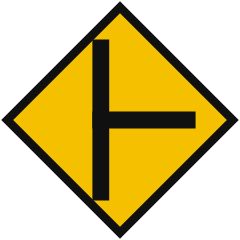
25. What condition does this sign warn a driver about?
Show answer
Answer B: Another road joins the road being traveled, from one side
It announces a side road entering the main roadway, so the driver should expect vehicles waiting to pull out and other vehicles slowing to turn in.
-
26. The crossing gates begin to lower while your vehicle is still on the railroad tracks. What should you do?
Show answer
Answer B: Keep going forward and push through the gate if it should block your way
Gates are made to break away, and driving forward off the tracks is far safer than staying between them or backing up.
-
27. Your passenger wants to carry a bag in one hand during the ride. What should you tell them?
Show answer
Answer B: No, both hands are needed to hold on, so the bag must be secured on the machine
A passenger needs both hands on the operator or the handholds, and anything carried loose can be dropped into the wheel or pull the passenger off balance.
-
28. You are in a passing zone that continues over the crest of a hill ahead. May you start a pass?
Show answer
Answer B: Only if you can finish it well before the crest
Beyond the crest you cannot see oncoming traffic, so any part of the pass that happens there is being made blind.
-
29. What is the purpose of the padding built into the shoulders, elbows and knees of riding gear?
Show answer
Answer C: It absorbs impact energy at the joints most likely to strike first
Armor at the joints spreads and absorbs the force of an impact in the places that usually hit the ground first in a fall.
-
30. You are traveling at 55 mph and see a vehicle ahead moving at about 15 mph. What is the hazard?
Show answer
Answer A: You reach it far sooner than you expect
At a 40 mph difference you cover the gap in a few seconds, which is why drivers strike slow vehicles they saw in plenty of time.
-
31. Where is the clutch lever located on a standard motorcycle?
Show answer
Answer D: On the left handlebar
Squeezing the lever on the left handlebar disengages the clutch and interrupts power between the engine and the rear wheel.
-
32. What limits how much weight a motorcycle can carry?
Show answer
Answer A: The load limit given by the manufacturer for that machine
The manufacturer's figure covers the rider, the passenger and everything carried, and going over it overloads the tires, the brakes and the suspension.
-
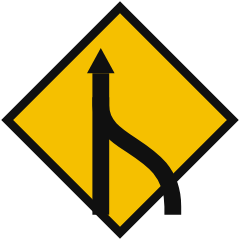
33. What does this sign warn a driver about?
Show answer
Answer A: Traffic from another roadway will enter the same lane ahead
Two traffic streams come together into one lane beyond this point, so drivers on both roadways have to adjust speed and spacing to fit together.
-
34. Which flashing light colors identify a stopped vehicle protected by Georgia's Move Over Law?
Show answer
Answer D: Yellow, amber, white, red or blue
Georgia describes the protected roadside vehicles as those displaying flashing yellow, amber, white, red or blue lights.
-
35. Which action makes a wobble worse instead of better?
Show answer
Answer A: Braking or accelerating to try to ride out of it
Braking or adding power during a wobble can amplify it. Close the throttle gradually, hold the bars firmly and let the speed fall until the machine settles.
-
36. You are circulating in the inner lane of a two-lane roundabout, your exit is next, and a vehicle is beside you in the outer lane. What should you do?
Show answer
Answer C: Keep circulating around the island and take that same exit on your next time around
You may not cut across a vehicle in the outer lane; if you cannot exit safely, continue around the circle and try again.
-
37. On an unlit road, about how far ahead do high beams normally let you see?
Show answer
Answer D: About 350 to 500 feet ahead of the vehicle
High beams light roughly 350 to 500 feet of road and low beams far less, which is why night speeds have to be chosen around the beam, not the limit.
-
38. You are approaching a multilane roundabout. When should you choose your lane?
Show answer
Answer C: Before you enter, using the lane-choice sign on the approach
You select your lane on the approach the way you would at any multilane intersection, then stay in that lane all the way around, because changing lanes inside a roundabout creates side-impact conflicts.
-
39. You are stopped at an intersection where bushes block your view of cross traffic. What should you do?
Show answer
Answer A: Edge forward slowly until you can see, then proceed when clear
Creeping forward a little at a time lets you gain a view without committing to the crossing. Never enter an intersection you cannot see into.
-
40. While you wait for the ambulance at a crash, what is the most useful help you can give?
Show answer
Answer C: Keep the person still and warm, and press down firmly on any heavy bleeding
Keeping an injured person still and warm and controlling bleeding are among the few things a bystander can safely do.