
Georgia DDS Permit Practice Test 5
- Questions40
- Correct to pass30
- Passing score75%
- Minimum age15 years
-
1. Federal law lets a state open its high-occupancy vehicle lanes to certain vehicles carrying only one person. Which of these is covered by that allowance?
Show answer
Answer B: Motorcycles
Federal law lets states allow motorcycles into high-occupancy vehicle lanes regardless of the number of occupants, because keeping riders in the flow is safer than the alternative.
-
2. Cones and drums mark a shifted lane through a work zone. What should you do?
Show answer
Answer A: Follow the path that they mark and stay inside it
Channelizing devices define the temporary travel path, and the space on the other side of them belongs to the workers.
-
3. A yellow diamond showing the silhouette of a deer warns that
Show answer
Answer D: large animals may cross the road in that area
The sign marks a stretch where animals are known to cross, so drivers should reduce speed and scan both roadsides, especially around dawn and dusk.
-
4. You are turning onto a street that has two lanes going your way. Which lane should you enter?
Show answer
Answer B: The lane closest to you, changing lanes later if you need to
Turn into the nearest lane going your direction and make any lane change afterwards, when you have signaled and checked that it is clear.
-
5. Once you have parallel parked, how close to the curb should your wheels be?
Show answer
Answer C: Within the distance your state allows, commonly 12 to 18 inches
Parking close to and parallel with the curb keeps the vehicle out of the traffic lane without damaging the tires; each state sets the exact maximum, usually 12 inches and 18 inches in some states.
-
6. You hold steady pressure on the brake pedal for the whole of a long descent. What is likely to happen?
Show answer
Answer B: The brakes overheat and fade, so they slow you less and less
Continuous braking heats the brakes until they fade and lose effectiveness; use a lower gear and short, firm applications instead.
-
7. A rear tire blows out on the highway. How does the vehicle usually behave?
Show answer
Answer C: The back end weaves or fishtails from side to side
A rear failure shows up as the tail wandering rather than a pull on the steering, so hold the wheel straight and let the speed drop gradually.
-
8. An orange sign showing the symbol of a person holding a flag or a sign paddle means that
Show answer
Answer D: a person is controlling traffic ahead and the driver must obey that person
The flagger sign warns that a trained flagger is directing traffic further on, and the flagger's instructions govern movement through the work zone.
-
9. A pedestrian waiting at a curb faces a steady upraised hand. What does that indication mean?
Show answer
Answer A: Do not start to cross in that direction
A steady upraised hand forbids entering the crosswalk, while a flashing hand only forbids starting a new crossing.
-
10. It is dusk and a jogger in dark clothing is running along the edge of the road. What should you do?
Show answer
Answer D: Slow down and scan the edges of the road
Dusk is the hardest light for spotting people, and dark clothing removes most of your warning, so lower speed and a careful scan of the roadsides are the answer.
-
11. A hands free phone conversation is which kind of distraction?
Show answer
Answer C: Cognitive, because your mind leaves the road
Hands free equipment removes the manual and visual parts of a call but not the mental load, and it is the mental load that makes a driver miss hazards.
-
12. A United States numbered route is normally marked with
Show answer
Answer C: black numerals on a white shield
The U.S. route marker is a white shield carrying black numerals, which sets it apart at a glance from the red, white and blue Interstate shield.
-
13. You see brake lights several vehicles ahead of you in your lane. What is the best first step?
Show answer
Answer C: Ease off the gas and cover the brake pedal
Reacting to the trouble several vehicles ahead, rather than waiting for the car in front, cuts your reaction time and warns the driver behind you.
-
14. On a wet road, how should a driver adjust after passing this sign?
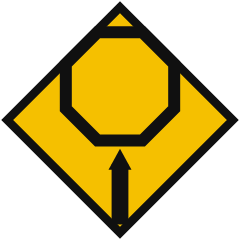
Show answer
Answer B: Start braking earlier, because a slippery surface lengthens the stopping distance
A wet surface lengthens stopping distance, so the extra warning distance should be spent braking gently and early instead of late and hard.
-
15. Where is a U-turn generally the most reasonable choice?
Show answer
Answer B: At an intersection where it is permitted and you can see well both ways
A U-turn needs a legal place and a long clear view in both directions, which is why a permitted intersection with open sight lines is the usual choice.
-
16. Your vehicle leaves the road and enters deep water. What gives you the best chance of escape?
Show answer
Answer B: Release your seat belt and get out through a window as quickly as possible
Water pressure holds the doors shut, so a window is the reliable exit and the first seconds after entry are the best time to use it.
-
17. What actually lowers the amount of alcohol in a person's blood?
Show answer
Answer D: The passage of time
The body eliminates alcohol at its own steady rate, so only time reduces blood alcohol. Coffee or a cold shower may make a person feel more awake while still impaired.
-
18. How does refusing the state administered chemical test affect a Georgia limited driving permit?
Show answer
Answer A: The driver becomes ineligible for a limited permit
A Georgia driver who refuses the state administered test is not eligible for a limited driving permit during the resulting suspension.
-
19. You have stopped on the shoulder of a busy freeway with a flat tire that you cannot change safely. Where should you and your passengers wait?
Show answer
Answer A: Well away from the traffic side, behind a barrier or up the bank if there is one
People struck on the shoulder are a common cause of roadside deaths, so wait away from the traffic side and behind any barrier.
-
20. The motorcyclist ahead of you keeps moving from one side of the lane to the other. What should you understand?
Show answer
Answer B: The rider is avoiding surface hazards and staying where drivers can see the bike
Riders shift their lane position to avoid debris, grease strips and potholes and to be seen. That movement is normal and never an invitation to share the lane.
-
21. You are driving through a neighborhood where several children are riding bicycles. What should you do?
Show answer
Answer C: Slow down and expect sudden, unpredictable moves
Young riders lack the judgment and the mirror habits of adults and may swerve or cross without looking, so lower speed is your only reliable margin.
-
22. On a highway with mileage-based exit numbering, you have just passed exit 42 and are looking for exit 55. About how far is it?
Show answer
Answer B: Thirteen miles
With mileage-based numbering each exit takes the number of the nearest milepost, so subtracting one exit number from another gives the distance in miles.
-
23. A vehicle is sitting in your blind spot and you need to change into that lane. What should you do?
Show answer
Answer B: Adjust your speed to open a clear gap, then check again and move over
Changing your speed either drops the other vehicle behind you or lets it move ahead, which turns the blind spot back into open space.
-
24. A bicycle symbol topped by two chevrons is painted in the middle of a travel lane. What does that marking indicate?
Show answer
Answer D: Bicyclists share the lane with motor vehicles and may ride away from the curb
A shared lane marking shows drivers where bicyclists are likely to ride in a lane used by both bicycles and motor vehicles.
-
25. You are involved in a collision, even a minor one. What is your first legal duty?
Show answer
Answer A: Stop at or near the scene without blocking traffic more than necessary
Every driver involved in a crash must stop at the scene, and leaving before meeting that duty is a serious offense. Move the vehicles only as far as needed to clear the traffic lanes.
-
26. On a rural road, the driver of a slow farm tractor ahead of you signals a left turn even though there is no road or driveway in sight. What should you do?
Show answer
Answer B: Stay behind the tractor, because it may be turning into a field entrance
Farm equipment often turns into fields through gaps you cannot see, and it may swing wide to do so. Passing a vehicle that is signaling a left turn is a common cause of crashes.
-
27. Your brake pedal sinks to the floor and the vehicle does not slow down. What is a reasonable sequence of actions?
Show answer
Answer C: Pump the pedal, shift to a lower gear and apply the parking brake gradually while steering to a safe spot
Pumping can rebuild pressure in a partly failed system, a lower gear adds engine braking, and easing on the parking brake slows the vehicle without locking the wheels.
-
28. Why should you set the parking brake even when an automatic transmission is in Park?
Show answer
Answer B: Because it takes the strain off the transmission and holds the vehicle
The parking pawl is a small part carrying the whole vehicle; the parking brake shares that load and holds the vehicle if the pawl fails.
-
29. After completing a turn you notice your signal is still flashing. What should you do?
Show answer
Answer A: Switch it off at once, before other drivers act on it
A signal left on after a turn is a false message, and drivers waiting to pull out may move into your path because of it.
-
30. Your vehicle is burning at the roadside. How far away should everyone keep?
Show answer
Answer D: At least a hundred feet away from the vehicle and upwind, out of the drifting smoke
Burning vehicles give off toxic smoke and parts such as tires and struts can burst, so keep a long distance and stay upwind.
-
31. Where should a rear-facing infant seat never be placed?
Show answer
Answer C: In a front seat with an active passenger air bag
A deploying front air bag strikes the back of a rear-facing seat with enormous force. Rear-facing seats belong in the back seat.
-
32. What does Georgia charge to reinstate a license after a first DUI suspension?
Show answer
Answer C: $200 by mail or $210 in person
Georgia charges $200 by mail and $210 in person to reinstate after a first DUI for a driver aged 21 or over.
-
33. You are stopped at an intersection where bushes block your view of cross traffic. What should you do?
Show answer
Answer A: Edge forward slowly until you can see, then proceed when clear
Creeping forward a little at a time lets you gain a view without committing to the crossing. Never enter an intersection you cannot see into.
-
34. What does this sign warn a driver about?
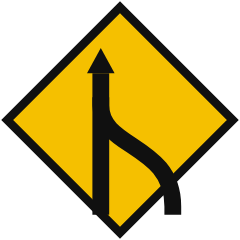
Show answer
Answer A: Traffic from another roadway will enter the same lane ahead
Two traffic streams come together into one lane beyond this point, so drivers on both roadways have to adjust speed and spacing to fit together.
-
35. What does this sign tell a driver about the road ahead?
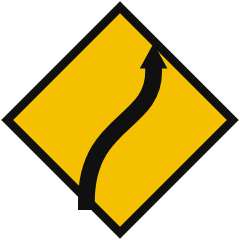
Show answer
Answer A: The roadway changes direction ahead, so speed should be reduced before reaching it
It gives advance notice of a change in alignment so the driver can slow down before entering, since braking inside a bend uses up grip that is needed for steering.
-
36. What additional requirement does Georgia place on license holders aged 64 and over?
Show answer
Answer A: A vision screening every eight years
Georgia requires customers who are 64 and over to complete a vision screening successfully every eight years.
-
37. Where must a Georgia child safety seat or booster seat be placed?
Show answer
Answer C: In the rear seat
Georgia requires the car seat or booster seat to be in the rear seat, appropriate for the child's weight and height, and installed as the manufacturer directs.
-
38. A large X with the letters R and R beside it is painted across your lane. What does it mean?
Show answer
Answer A: A railroad crossing lies a short distance ahead
The pavement marking repeats the advance warning for a grade crossing, and it is used on paved approaches where speeds are high or where gates are installed.
-
39. What does Georgia charge for a Class C Instructional Permit or a Class D Provisional License?
Show answer
Answer D: $10
Georgia prices both the instructional permit and the provisional license at $10, well below the standard license fee.
-
40. What does a tire with worn tread do on a wet road?
Show answer
Answer B: It loses grip and it hydroplanes at a lower speed than a good tire
Tread grooves carry water away from the contact patch, and a worn tire cannot do that, so it floats on the water sooner.