
Georgia DDS Permit Practice Test 23
- Questions40
- Correct to pass30
- Passing score75%
- Minimum age15 years
-
1. You are traveling beside a tractor-trailer and cannot see the truck driver's face in any of the truck's mirrors. What does that tell you?
Show answer
Answer A: The truck driver probably cannot see your vehicle
Large trucks have deep blind spots on all four sides, so if the driver's face is not visible in a mirror the driver has no view of you. Move ahead or drop back until you are out of that area.
-
2. How far ahead should you normally be looking while driving?
Show answer
Answer D: About 12 to 15 seconds of travel ahead
Looking that far ahead, roughly a block in town and much farther on a highway, gives you time to see a problem developing and adjust before it becomes an emergency.
-
3. On a school speed limit sign, the part carrying the word SCHOOL is shown
Show answer
Answer A: in black on a fluorescent yellow-green background
The SCHOOL portion of the school speed limit sign uses the same fluorescent yellow-green background as school warning signs, while the speed portion keeps the standard regulatory appearance.
-
4. You are passing a line of slow traffic in the lane beside you and you notice a gap in that line ahead. What should you expect?
Show answer
Answer A: A vehicle may pull out of that gap into your lane
A gap in a slow line is an invitation to any driver waiting to turn out of a side street or to change lanes, and they are looking at the gap rather than at you.
-
5. Who must accompany the holder of a Georgia Class C Instructional Permit?
Show answer
Answer B: A person at least 21 years old licensed for a Class C vehicle, seated beside the driver
Georgia requires a person at least 21 years old who holds a Class C license, is capable of controlling the vehicle, and occupies the seat beside the driver.
-
6. What is sensible when you drive in an unfamiliar town for the first time?
Show answer
Answer C: Drive a little slower and give yourself more time to read the signs
In unfamiliar surroundings you need longer to take in signs, junctions and markings, and lower speed buys that time.
-
7. You have driven at 70 mph for an hour and then exit onto a town street. What is the common risk?
Show answer
Answer B: Your sense of speed adapts, so 35 mph feels slow and you drive too fast
After a long stretch at high speed the brain adapts, so town speeds feel unnaturally slow; check the speedometer instead of trusting the feeling.
-
8. Which sign tells you that the vehicles ahead are part of a funeral procession?
Show answer
Answer C: Headlights burning in daylight, with small flags or markers on the vehicles
Processions are normally identified by daytime headlights, hazard lights and flags or windshield markers, not by emergency lights or sirens.
-
9. Two left-turn lanes are available and you must turn right again a short distance after the turn. Which of the two should you use?
Show answer
Answer D: The right one, so you finish nearer the right side of the new street
Each turn lane feeds the matching lane of the new street, so choosing the right-hand of the two left-turn lanes leaves you closer to the side you will need.
-
10. You have a small extinguisher and a fire has started under the hood. What is the safe way to use it?
Show answer
Answer B: Release the latch and spray through the gap without raising the hood at all
Opening the hood feeds the fire a rush of air, so spraying through the gap at the base of the flames is both safer and more effective.
-
11. How should the inside rearview mirror be adjusted?
Show answer
Answer B: So you can see the entire rear window without moving your head
The inside mirror is for the view straight behind you. Framing the whole rear window from your normal seating position gives the widest useful view.
-
12. You see smoke coming from under the hood while driving. What should you do?
Show answer
Answer D: Signal, pull well off the road, shut off the engine and move everyone away from the vehicle
Stopping and shutting off the engine cuts the fuel supply to a possible fire, and distance protects you if it spreads. Raising the hood can feed the fire a rush of air.
-
13. You have a green arrow to turn left. What still applies?
Show answer
Answer D: You must yield to any pedestrian or vehicle still inside the intersection
A green arrow protects your turn from conflicting traffic, but you must still let anyone already in the intersection get clear before you move.
-
14. The vehicle you have borrowed is larger and heavier than your own. How should you drive it?
Show answer
Answer B: Allow more room for stopping and for turns until you are used to it
Extra weight and length mean longer stopping distances and wider turns, so give yourself more room until you are used to it.
-
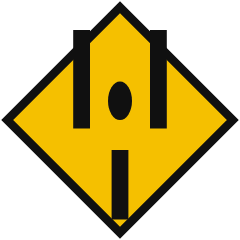
15. What change in the road does this sign announce?
Show answer
Answer B: The two directions of travel are about to be separated, and the driver must keep to the right of the separation
Ahead the roadway splits into separate one-way roadways on either side of a median, so the driver stays to the right of the divider and no longer meets oncoming vehicles.
-
16. You see a shield for a three-digit Interstate whose first digit is even. What does that tell you about the route?
Show answer
Answer C: It loops around a city and rejoins its parent route
A three-digit Interstate beginning with an even digit is a loop or beltway that connects back to the main route at both ends, while an odd first digit marks a spur.
-
17. A sign beside the signal reads STOP HERE ON RED. What does it tell you?
Show answer
Answer B: Stop at that point on red, not closer to the intersection
The sign marks the required stopping point, which is set back from the corner so that turning vehicles and sight lines are not blocked.
-
18. A school sign paired with a plaque showing a diagonal downward-pointing arrow is installed
Show answer
Answer D: at the school crossing itself, or as close to it as possible
The diagonal downward arrow points at the crossing, so this assembly is placed at the crossing location rather than in advance of it.
-
19. A highway lane is marked with a large white diamond and signed as a high-occupancy vehicle lane. Who may use it?
Show answer
Answer B: Only vehicles carrying at least the number of occupants shown on the sign, during the posted hours
The diamond marking identifies a preferential lane whose occupancy requirement and hours of operation are stated on the accompanying signs.
-
20. How many points does an open container conviction add to a Georgia driving record?
Show answer
Answer A: Two points
Georgia's points schedule assigns two points to an open container violation under code section 40-6-253.
-
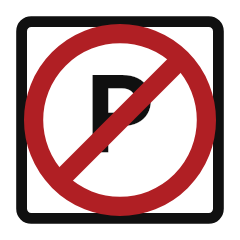
21. Why is this restriction so common beside fire hydrants, crosswalks and intersection corners?
Show answer
Answer C: To keep sight lines open and leave access for emergency crews
A vehicle left in those places hides pedestrians from approaching drivers, blocks the path of turning vehicles and can keep firefighters from reaching a hydrant.
-
22. A dust storm is blowing across the highway ahead of you. What is the recommended response?
Show answer
Answer B: Leave the road if you can, park well clear and take your foot off the brake
Get well off the pavement, switch the lights off and keep your foot off the brake, so drivers still on the road do not follow your tail lights off the highway.
-
23. In most states, how far before a turn must your signal already be on in city traffic?
Show answer
Answer B: At least 100 feet, roughly the length of six or seven cars
Most states require the signal for at least 100 feet before a turn in city driving, which gives drivers behind you time to react before you slow; several require more at higher speeds.
-
24. Is dictating a message by voice a safe alternative to typing one?
Show answer
Answer C: No, it still takes attention from driving
Composing and checking a spoken message loads the mind and usually pulls the eyes to the screen anyway, so research finds it no safer than other phone use.
-
25. You are driving in fog so thick that you can barely see the vehicle ahead. Which pavement marking is the best guide for staying in your lane?
Show answer
Answer A: The white edge line on the right side of the road
The right edge line keeps you positioned away from oncoming traffic and is easy to follow at low speed. Following tail lights closely tempts you to drive faster than you can see.
-
26. Why is it useful to watch the vehicle two or three places ahead of you?
Show answer
Answer C: You get an earlier warning of slowing traffic than brake lights give
Trouble travels back through a line of traffic, so seeing it start several vehicles ahead gives you a head start on braking.
-
27. Traffic ahead of you has stopped in your lane while the next lane is still moving. What is the first thing to do?
Show answer
Answer C: Slow down first and check the next lane before moving over
Braking is the action that keeps you from hitting the stopped traffic, and the lane change is only safe once you have looked.
-
28. When should most of your braking for a turn be finished?
Show answer
Answer B: Before you begin to turn the wheel
Slow to the right speed before the turn begins; braking hard while turning uses up the grip the tires need for steering.
-
29. A set of reversible express lanes is closed off with gates and signs while it runs the other way. What must you never do?
Show answer
Answer C: Enter past a closed gate or a sign showing the lanes are closed
When reversible lanes are closed they may already be carrying traffic in the opposite direction, so entering past a gate can put you head-on into that traffic.
-
30. A center lane is bordered by a solid yellow line on the outside and a broken yellow line on the inside, with left-turn arrows painted in it. How may you use that lane?
Show answer
Answer A: Only to make a left turn or to prepare for one from either direction
That marking identifies a two-way left turn lane, which may only be used for left turns or to prepare for a left turn and never for travel or passing.
-
31. There is a stop sign but no stop line and no crosswalk. Where must you stop?
Show answer
Answer A: Before entering the intersection, where you can see cross traffic
With no line or crosswalk, stop before you enter the intersection at the point where you can see traffic on the cross street.
-
32. Crossing a parking lot on a hot day, you see a young child alone in a locked car. What should you do?
Show answer
Answer A: Call 911 right away and stay with the vehicle
The inside of a parked car can reach lethal temperatures within minutes, so a child left alone in one is an emergency.
-
33. A tow truck with flashing amber lights is loading a car on the shoulder ahead. How should you treat it?
Show answer
Answer B: Give it the same room as an emergency vehicle
Tow operators, utility crews and highway workers face the same danger from passing traffic, so move over or slow down for their flashing amber lights too.
-
34. What school-related proof must a Georgia applicant under 18 provide?
Show answer
Answer B: Proof of enrollment and of not being under expulsion
Georgia requires an applicant under 18 to document school enrollment and to show that the applicant is not under expulsion, for example with a DS-1 Certificate of School Enrollment.
-
35. Roughly how far does a vehicle travel at 55 mph during the few seconds a driver spends reading a text message?
Show answer
Answer D: About the length of a football field
Sending or reading a message takes the eyes off the road for about five seconds, which at 55 mph covers roughly the length of a football field with nobody watching the road.
-
36. A yellow lamp flashes above a warning sign at a sharp curve. What does it ask of a driver?
Show answer
Answer D: Slow down and pass the point with extra care
A warning beacon draws attention to the sign it is mounted with, and the message of the sign is what the driver must act on.
-
37. What is true about an airbag once it has inflated in a crash?
Show answer
Answer B: It must be replaced by a technician before the car is driven any further
An airbag is a single use device, and the module and often the belts must be replaced before the vehicle protects anyone again.
-
38. A power line has fallen across your vehicle after a crash. What should you do?
Show answer
Answer C: Stay inside and wait for utility workers unless fire forces you out
The vehicle body may be energized, and touching it and the ground at the same time can be fatal. If you must leave because of fire, jump clear with both feet together and shuffle away.
-
39. The trapezoid sign shape is associated with
Show answer
Answer C: recreational and cultural interest area signing
The trapezoid is used for recreational and cultural interest area guide signs and for national forest route markers.
-
40. Where is a road work ahead sign placed?
Show answer
Answer B: In advance of the work space or detour, so drivers are warned before reaching it
Advance warning signs are placed upstream of the work space or detour so that drivers have time to slow down and change lanes before reaching the activity.