
Georgia DDS Permit Practice Test 19
- Questions40
- Correct to pass30
- Passing score75%
- Minimum age15 years
-
1. The center line beside your lane is a broken yellow line. What does it allow?
Show answer
Answer D: You may cross into the opposing lane to pass when it is safe and clear
A broken yellow center line marks a passing zone where traffic in that direction may cross into the opposing lane to pass when the way ahead is clear.
-
2. A pedestrian near the curb is staring at a phone and not looking at traffic. What should you do?
Show answer
Answer A: Slow down and be ready to stop, because the pedestrian may step out without looking
Distracted pedestrians step into the street without checking. Assume they have not seen you and give yourself time and space to stop.
-
3. How should tire pressure be checked and set?
Show answer
Answer B: When the tires are cold, set to the pressure specified by the vehicle manufacturer
Driving heats the air and raises the reading, and the sidewall number is a maximum rather than a recommendation, so check cold and use the figure on the vehicle placard or in the owner's manual.
-
4. How does a NO OUTLET sign differ from a DEAD END sign?
Show answer
Answer B: It warns that a whole group of streets has no way out
No Outlet is posted where the road leads into a network of streets from which there is no through route, while Dead End refers to the single street itself.
-
5. How does braking distance change if you double your speed?
Show answer
Answer D: It grows much more than twice as long
Braking distance increases with the square of speed, so doubling speed roughly quadruples the distance needed to stop.
-
6. A sign on a divided highway reads Keep Right Except to Pass. What does it require of you?
Show answer
Answer A: Use the left lane only to overtake, then return to a lane on the right
The left lane on such a highway is reserved for overtaking, so a driver who has finished a pass must move back to the right.
-
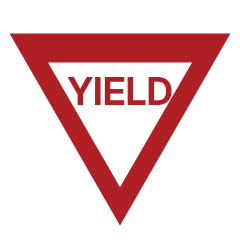
7. A driver reaches this sign and the intersecting roadway is completely clear. What is required?
Show answer
Answer D: Slowing to a speed that allows stopping, then going on without stopping if the way stays clear
This control asks the driver to slow down and be ready to stop, and a full stop becomes necessary only when traffic or pedestrians would otherwise be interfered with.
-
8. Under the Georgia Safety Responsibility Law, how can a driver avoid suspension after a claim is filed for crash damage?
Show answer
Answer A: Have the insurance carrier file Form SR-21, file a signed release from the claimant, or post security with DDS
Georgia lets the driver avoid suspension by having the insurer file Form SR-21, by filing a general or conditional release signed by the injured party, or by posting security for the damages.
-
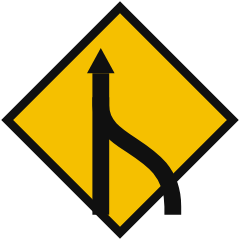
9. What is the safest way to deal with the situation this sign announces?
Show answer
Answer B: Match the speed of the other traffic stream and open a gap so vehicles can blend without hard braking
Blending works when speeds are matched and gaps are opened, so nobody has to brake hard or swerve where the two streams come together.
-
10. In the Georgia road test parallel parking exercise, how close to the curb must the vehicle finish?
Show answer
Answer A: Not more than 18 inches from the curb
Georgia requires the vehicle to end up no more than 18 inches from the curb, parked midway between the two standards.
-
11. Why must you never leave the engine running in a closed garage?
Show answer
Answer B: Because carbon monoxide builds up and can kill within minutes
Exhaust gas contains carbon monoxide, which has no smell or color and can reach fatal levels in an enclosed space very quickly.
-
12. Unless a sign says otherwise, what is the Georgia speed limit on an urban interstate or a multi-lane divided highway?
Show answer
Answer C: 65 miles per hour
Georgia sets 65 miles per hour for urban interstates and multi-lane divided highways, and 55 for all other areas not otherwise covered.
-
13. What is the first thing to do once your disabled vehicle is stopped on the shoulder?
Show answer
Answer A: Switch on the hazard warning lights so other drivers can see the vehicle
Hazard lights are the fastest way to make a stopped vehicle visible, and everything else can follow once traffic has been warned.
-
14. A yellow sign ahead of an underpass reads LOW CLEARANCE 12 FT 6 IN. What does the figure tell you?
Show answer
Answer B: The greatest height that can pass beneath the structure
The figure is the actual clearance available, so a vehicle taller than that must leave the road and take a marked alternative route.
-
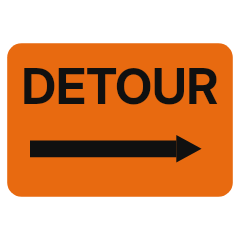
15. Once a driver has joined the route this sign begins, how is the rest of the way marked?
Show answer
Answer B: By further markers of the same kind at each turn, until the original road is rejoined
The alternate route is signed continuously, with a marker at every turn, so a driver with no local knowledge can follow it back to the original road.
-
16. You are waiting to turn left at a solid green light with no green arrow. Oncoming traffic is approaching. What should you do?
Show answer
Answer A: Yield to the oncoming traffic and turn only when there is a safe gap
A solid green light permits the left turn but does not protect it, so you must yield to oncoming vehicles and to pedestrians before turning.
-
17. The accelerator sticks open while you are driving. What is the first thing to do?
Show answer
Answer A: Shift into neutral and brake while steering off the road
Neutral disconnects the engine from the wheels so the vehicle can be braked normally, while shutting off the ignition may lock the steering and remove power assistance.
-
18. The low sun is directly ahead and glare makes it hard to see. What should you do?
Show answer
Answer C: Slow down, use the sun visor or sunglasses, and increase following distance
Sun glare can hide pedestrians, brake lights and signals. Reducing speed and adding space gives you time to react to what you cannot yet see.
-
19. You are backing straight down a driveway while looking over your right shoulder. Where should your left hand be?
Show answer
Answer C: At the top of the steering wheel, holding it with a firm grip
With one hand at the top of the wheel you can hold a straight course and make small corrections while your body is turned to look behind.
-
20. You are already inside a roundabout when an emergency vehicle approaches with lights and siren. What should you do?
Show answer
Answer B: Continue to your exit, leave the roundabout, then pull over and stop
Stopping inside a roundabout blocks the circulating roadway, so you should exit first and then pull over clear of the intersection.
-
21. A disabled vehicle is blocking your lane on a two-lane road with a single solid yellow line on your side. What should you do?
Show answer
Answer C: Wait until the oncoming lane is clear, then go around carefully
The solid line prohibits overtaking a moving vehicle, but in most states a driver may go around an obstruction such as a disabled vehicle once the oncoming lane is clear and the move can be made safely.
-
22. You began a turn from the wrong lane and are already inside the intersection. What should you not do?
Show answer
Answer A: Reverse in order to get back into the correct lane
Backing up in an intersection puts you into the path of traffic that cannot expect it; finish the movement and fix your position afterwards.
-
23. You are waiting in a left-turn lane at a green light when a fire engine with lights and siren comes toward you in the oncoming lanes. What should you do?
Show answer
Answer D: Hold your position and let the fire engine pass
Turning across the path of an approaching emergency vehicle is exactly what you must not do; stay put until it has gone by.
-
24. While you wait for the ambulance at a crash, what is the most useful help you can give?
Show answer
Answer C: Keep the person still and warm, and press down firmly on any heavy bleeding
Keeping an injured person still and warm and controlling bleeding are among the few things a bystander can safely do.
-
25. Which color scheme is standard for the drums and barricades that channel traffic through a work zone?
Show answer
Answer C: Alternating orange and white retroreflective stripes
Drums and barricades carry alternating orange and white retroreflective stripes, and the traffic cones used in the same zones are predominantly orange.
-
26. You have stopped on the shoulder of a highway and want to rejoin the traffic. What is the correct way?
Show answer
Answer D: Signal, build up speed along the shoulder, then merge into a gap
Entering a fast lane at a slow speed is what causes the conflict, so the shoulder is used to gain speed before the merge in the same way as an acceleration lane.
-
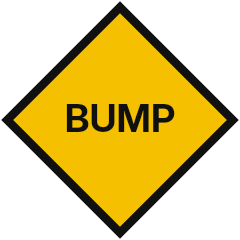
27. Why does this warning matter more on a motorcycle than in a car?
Show answer
Answer B: Because a sudden jolt can unsettle a two-wheeled machine and the rider can lose control
A jolt can push a motorcycle off line or lift a wheel, so a rider slows early, comes slightly off the seat and keeps a relaxed but firm hold on the handlebars.
-
28. How long must a Georgia applicant wait before retaking a failed part of the road test?
Show answer
Answer B: Until the next day after a first failure, then seven days after any later failure
Georgia lets an applicant return the next day after a first failure, but imposes a seven-day wait after a second or later failure.
-
29. A large truck is passing you on a two-lane road. What is the safest thing to do?
Show answer
Answer C: Keep right in your lane and ease off the gas a little
Staying in your own lane and easing off shortens the pass without forcing you onto a soft shoulder or into the truck's path.
-
30. A yellow diamond shows a horse with a rider. Besides slowing down, what else should a driver do?
Show answer
Answer C: Avoid using the horn or revving the engine
The equestrian crossing sign warns of horses on or across the road, and a sudden noise can startle an animal into the traffic lane.
-
31. You are backing out of a home driveway onto a street with a sidewalk. Who must you yield to?
Show answer
Answer D: All traffic on the street and everyone on the sidewalk
A driver entering the roadway from private property yields to everyone already using the sidewalk and the street.
-
32. At an intersection where every approach carries this sign, two drivers arrive at exactly the same instant. Which of them goes first?

Show answer
Answer C: The driver on the right
Order of arrival decides who goes first, and when two vehicles arrive together the driver on the right proceeds while the other gives way.
-
33. The word SCHOOL is painted in large letters across the roadway. What is it doing?
Show answer
Answer D: Backing up the signs marking a school zone
Word markings on the pavement reinforce a message that is already signed, and a driver looking at the road ahead cannot miss them.
-
34. Why are pedestrians and cyclists a special risk on unlit streets at night?
Show answer
Answer A: Dark clothing can make them invisible until they are very close
A person in dark clothing reflects almost no light and may not appear until they are inside your stopping distance, so cut your speed where people may be about.
-
35. You feel dizzy and get a headache while driving with the windows closed. What could be the cause and what should you do?
Show answer
Answer D: An exhaust leak letting carbon monoxide into the cabin, so open the windows and stop to get fresh air
Carbon monoxide is colorless and odorless, and headache, dizziness and drowsiness are early signs. Get fresh air at once and have the exhaust system inspected.
-
36. During the reversing part of a three-point turn, where should you be looking?
Show answer
Answer C: Over your shoulder through the rear window, glancing both ways
You look through the rear window in the direction the car is moving, checking both ways for traffic and people, because mirrors and cameras leave blind areas.
-
37. May you stop in the striped triangle that separates an exit ramp from the freeway lanes?
Show answer
Answer A: No, it is not a lane and stopping there is dangerous
The striped gore area is not a travel lane or a shoulder, and a vehicle stopped there sits directly in the path of drivers correcting a late exit.
-
38. How do Georgia's HOV lane penalties escalate?
Show answer
Answer D: Up to $75, then $100, then $150, with a point added on a fourth offense
Georgia fines HOV lane violations up to $75, $100 and $150 for the first three offenses, and adds a point to the record from the fourth.
-
39. You are driving through a residential area where parked cars hide the side streets. What is the safest approach?
Show answer
Answer C: Slow down and cover the brake as you pass each opening
Where parked vehicles hide side streets and driveways, lower speed and a covered brake buy the time you lose in sight distance.
-
40. How should a head restraint be adjusted?
Show answer
Answer D: So the top is at least as high as the back of your head and close behind it
A restraint set at head height and close behind limits how far the head snaps backward in a rear impact, which is what reduces neck injury.