
Georgia DDS Permit Practice Test 12
- Questions40
- Correct to pass30
- Passing score75%
- Minimum age15 years
-
1. How does alcohol affect a driver's ability to handle several things at once?
Show answer
Answer B: It cuts the ability to divide attention between tasks
Driving means watching the road, the mirrors and the instruments together, and alcohol narrows attention so that one of those tasks is dropped without the driver noticing.
-
2. What is the sensible way to handle a meal on a long drive?
Show answer
Answer D: Eat before you leave or stop to eat
Eating takes hands, eyes and attention, and the only version with no cost to your driving is the one that happens while the car is parked.
-
3. What should you do about snow and ice on your vehicle before driving?
Show answer
Answer C: Clear all glass, mirrors and lights, and the roof and hood as well
Snow left on the roof or hood slides onto your windshield when you brake and blows into the path of drivers behind you, and covered lights make your vehicle hard to see.
-
4. Your steering suddenly feels light and unresponsive as you drive through standing water. What should you do first?
Show answer
Answer A: Ease off the accelerator and keep the steering wheel pointed straight
Those symptoms mean the tires are riding on a film of water, and gently lifting off the accelerator lets them settle back onto the pavement. Hard braking or sudden steering while hydroplaning can start a skid.
-
5. A black on white regulatory sign at an intersection reads NO TURNS. What may a driver do there?
Show answer
Answer B: Only continue straight through the intersection
The NO TURNS sign bans turns in every direction at that intersection, so the only lawful movement from that approach is straight through.
-
6. How should you position your vehicle for a right turn from a two-way street?
Show answer
Answer B: As close as practical to the right curb or edge, then turn into the nearest right lane
Right turns are made from the lane nearest the right edge into the nearest available lane, which keeps the turn tight and prevents a wide sweep into other traffic.
-
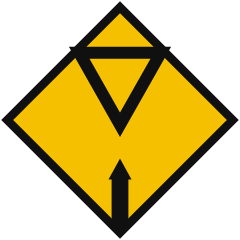
7. What will the driver have to do at the point this sign refers to?
Show answer
Answer C: Slow down and let conflicting traffic go first, stopping if that is what it takes
Further along, the driver has to let conflicting traffic and pedestrians go first, reducing speed and stopping whenever that is necessary to avoid interfering with them.
-
8. Traffic is entering the freeway from a ramp ahead of you and you are in the right lane. What should you do?
Show answer
Answer C: Move to another lane if it is safe, or adjust your speed to make room
Merging drivers may have little room to adjust. Helping them in by changing lanes or easing your speed prevents conflicts even though they must legally yield to you.
-
9. A broken white line separates your lane from the lane on your right. What does it permit?
Show answer
Answer C: Changing lanes when it is safe to do so
A normal broken white line marks a boundary between lanes traveling the same way that road users may cross when it is safe.
-
10. The route marker used for an Interstate highway is a shield with
Show answer
Answer A: white numerals on a blue field under a red band carrying the word INTERSTATE
The Interstate route marker is a cutout shield with a white border, the word INTERSTATE in white on red across the top and the route number in white on blue.
-
11. A school bus ahead of you has its red lights flashing and its stop arm extended. What are you required to do?
Show answer
Answer A: Stop and stay stopped until the lights stop flashing and the bus starts moving
Flashing red lights and an extended stop arm mean children are getting on or off, so traffic must stop and wait until the bus withdraws the signals and moves again.
-
12. You have parked a manual transmission car facing downhill. Which gear should you leave it in?
Show answer
Answer D: Reverse, along with the parking brake set firmly
Facing downhill the car would roll forward, so reverse gear opposes that movement while the parking brake and turned wheels back it up.
-
13. When are the hazard warning lights properly used?
Show answer
Answer A: When your vehicle is stopped or barely moving and is a hazard
Hazard lights warn that your vehicle is an obstruction; they do not authorize illegal parking and they hide your turn signals while driving.
-
14. At an intersection where turning right on red is permitted and no sign prohibits it, what must you do before turning?
Show answer
Answer A: Come to a complete stop and yield to pedestrians and cross traffic
A right turn on red is allowed only after a full stop, and the turning driver must yield to pedestrians in the crosswalk and to traffic already using the intersection.
-
15. What is the minimum suspension in Georgia for refusing a state administered chemical test?
Show answer
Answer A: One year
Georgia's implied consent law suspends the license or driving privilege for a minimum of one year when a driver refuses state administered testing.
-
16. What should you check on the hitch before towing a trailer?
Show answer
Answer B: That the coupler is locked and the safety chains are crossed underneath
The coupler must be latched and pinned, and the chains crossed under the tongue so they cradle it if the coupling lets go.
-
17. Where is a U-turn most clearly unsafe and generally prohibited?
Show answer
Answer D: On a curve or near a hill crest, where other drivers cannot see you
U-turns are barred where approaching drivers cannot see you in time, such as on a curve or near the top of a hill.
-
18. Why is parking next to a fire hydrant or in a marked fire lane prohibited?
Show answer
Answer D: It would delay firefighters who need immediate access to the hydrant or the building
Fire hydrants and fire lanes must remain clear at all times so emergency crews can connect hoses and reach a building without delay.
-
19. How does going a long time without sleep compare with drinking?
Show answer
Answer A: It can impair a driver in much the same way
Long periods awake produce slow reactions, poor judgment and lapses of attention that resemble the effects of alcohol, which is why fatigue counts as impairment.
-
20. Someone stops drinking heavily at two in the morning and drives to work at eight. What is true?
Show answer
Answer A: They may still be impaired and over the limit
The body removes alcohol at a slow, fixed rate, so a heavy night can leave a driver impaired well into the next morning no matter how they feel.
-
21. A law enforcement officer is directing traffic and waves you forward while the signal facing you shows red. What should you do?
Show answer
Answer A: Follow the officer's direction and proceed
Directions given by an officer controlling traffic take priority over signals, signs and pavement markings.
-
22. You feel fine twenty minutes after your last drink. Why is that a poor guide to driving?
Show answer
Answer B: Your blood alcohol level can still be rising
Alcohol keeps being absorbed for some time after the last drink, so a driver who feels able at the door can be more impaired a few miles down the road.
-
23. Once you are moving, which way of using a navigation device costs you the least attention?
Show answer
Answer B: Listening to the spoken directions
Voice guidance lets you keep your eyes on the road, while anything that needs the screen takes glances that add up over a trip.
-
24. You are about to pull out from a stop sign. Which scanning habit is correct?
Show answer
Answer A: Look to the left, then to the right, then to the left again before moving
Traffic from the left reaches you first, and a second look left catches anything that arrived while you were looking right.
-
25. You are turning left at an intersection and an oncoming bicyclist is approaching in the bike lane. What must you do?
Show answer
Answer B: Yield and complete the turn only after the bicyclist has passed
A bicycle in the roadway has the same right of way as a vehicle, so a left-turning driver must yield to an oncoming rider just as to an oncoming car.
-
26. A line beside your lane is painted about twice the normal width. What does the extra width convey?
Show answer
Answer B: Greater emphasis on the restriction it carries
Width is part of the marking code: a wide line carries more emphasis than a normal one, which is why it is used at gores and channelizing lines.
-
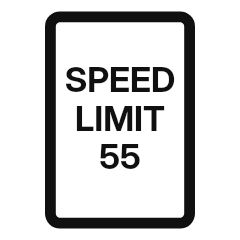
27. On a clear day with light traffic, a driver stays far below the maximum this sign sets. What can that cause?
Show answer
Answer B: Obstruction of the normal flow of traffic, which is prohibited in itself
Driving so slowly that other traffic is impeded is an offense in its own right when nothing about safety, weather or the road calls for it.
-
28. Why is a sign reading BRIDGE ICES BEFORE ROAD worth heeding even when the road itself is merely wet?
Show answer
Answer C: Cold air passes under a bridge as well as over it
A bridge deck loses heat from below as well as above, so it can be frozen while the road on either side of it is only wet.
-
29. Two roads come together at a shallow angle under a MERGE sign, with no yield line on either one. What is expected of you?
Show answer
Answer D: Adjust your speed and position so you blend smoothly into the other traffic
A merge means neither road ends at a stop; drivers adjust speed and position so that the two streams fit together without stopping.
-
30. You realize your tires are running on ice. Which set of inputs is safest?
Show answer
Answer C: Gentle steering, no sudden braking, and no sudden acceleration
Whatever grip is left is used up at once by any sudden input, so every movement of wheel, brake and accelerator must be slow and small.
-
31. You turn the wheel but the front of the vehicle keeps sliding straight ahead on a slippery road. What should you do?
Show answer
Answer C: Ease off the accelerator and reduce the steering angle until the front tires grip again
A front-wheel skid means the tires are asking for more grip than the surface can give. Less speed and less steering angle let them regain traction.
-
32. A pedestrian steps off the curb without looking your way. What should you assume?
Show answer
Answer B: That the person has not seen you at all, and be ready to stop for them
Defensive driving means assuming you have not been seen until there is clear evidence that you have.
-
33. A loaded truck is coming up an entrance ramp as you approach in the right lane of the freeway. What is the most helpful action?
Show answer
Answer A: Adjust your speed to open a gap for it
A heavy vehicle accelerates slowly, so opening a gap or moving over costs you seconds and saves the truck driver from being forced to stop on the ramp.
-
34. On a street with parking along the curb, the shared lane marking is painted well out from the curb face. What does that placement tell a bicyclist?
Show answer
Answer C: To ride clear of the doors of parked cars
The marking is set at least eleven feet from the curb where parking is allowed so that riders are guided outside the reach of an opening door.
-
35. When are you expected to switch from high beams to low beams?
Show answer
Answer D: When a vehicle approaches from ahead or you come up behind another vehicle
High beams blind other drivers, both those coming toward you and those you follow through their mirrors. Dim them whenever another vehicle is within range.
-
36. You are turning right off a street into a parking lot driveway that crosses a bike lane and a sidewalk. Who has the right of way?
Show answer
Answer D: Pedestrians on the sidewalk and riders in the bike lane
Turning into a driveway means crossing the paths of people who were already traveling straight, so you give way to both the bike lane and the sidewalk.
-
37. Travelling at about 55 mph on dry pavement, roughly how much room does an average car need to perceive, react and stop?
Show answer
Answer D: About 300 feet, close to the length of a football field
Reaction distance plus braking distance at 55 mph comes to roughly 300 feet on good dry pavement, and considerably more on a wet or loose surface.
-
38. Which vehicle is most affected by a strong side wind?
Show answer
Answer D: A van or a car towing a tall trailer
Wind pushes against the side area of a vehicle, so tall boxy shapes and trailers are moved far more than low heavy ones.
-
39. How should a lap and shoulder belt be positioned?
Show answer
Answer A: Lap belt low across the hips and shoulder belt across the chest and collarbone
The lap belt must bear against the strong pelvic bones rather than soft organs, and the shoulder belt must cross the rib cage and collarbone so crash forces spread over the skeleton.
-
40. You have finished a distracting task and your eyes are back on the road. What is true?
Show answer
Answer A: Your full attention takes a while to come back
Studies of drivers show attention lags behind the eyes for many seconds after a phone or a screen task, so the danger continues after the task is over.